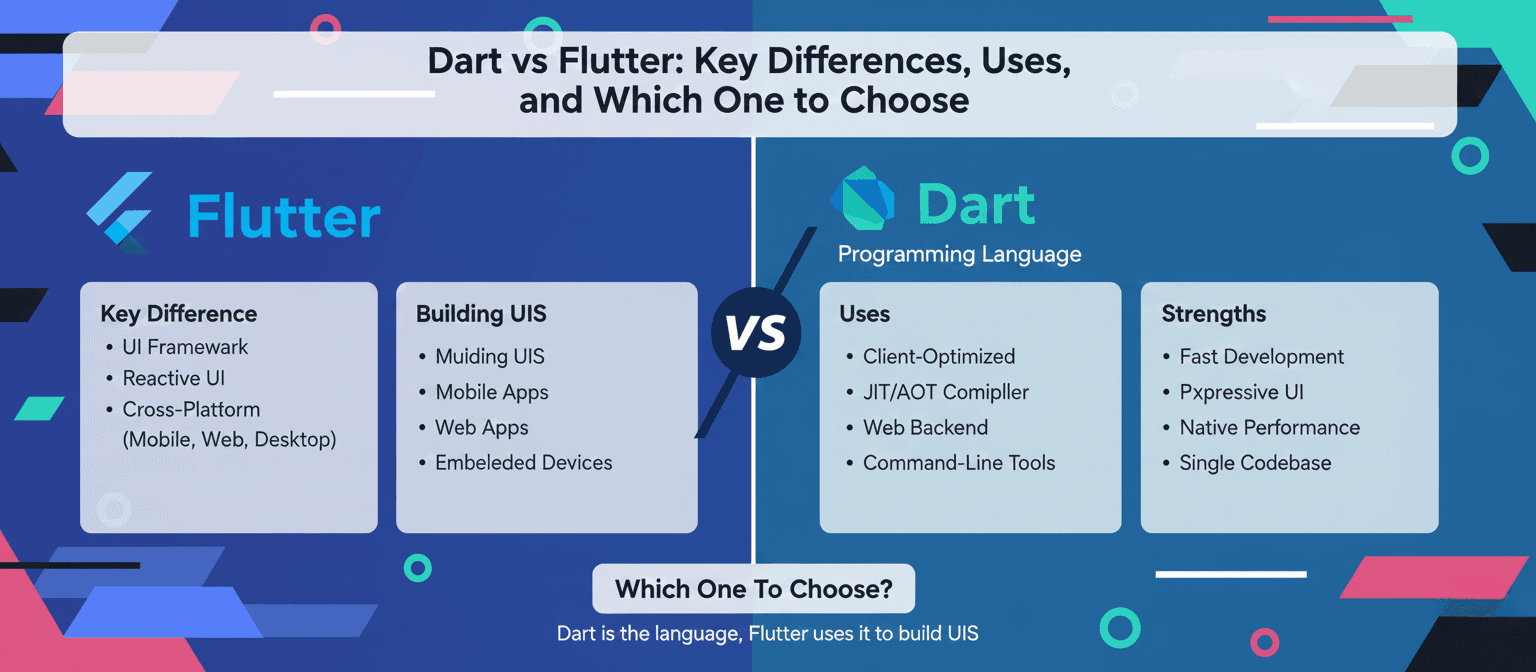
Dart vs Flutter: Key Differences, Uses, and Which One to Choose
When entering the world of cross-platform app development, two names often appear together: Dart and Flutter. Many beginners assume they are competitors, but in reality, they serve different purposes. This article explains the difference between Dart vs Flutter, their roles, advantages, and how they work together.
What Is Dart?
Dart is a programming language developed by Google. It is used to build mobile, web, desktop, and server applications. Dart is an object-oriented language with syntax similar to Java, C#, and JavaScript, making it easy to learn for most developers.
Key Features of Dart
- Strongly typed programming language
- Supports both Just-In-Time (JIT) and Ahead-Of-Time (AOT) compilation
- High performance and fast execution
- Simple syntax and clean code structure
- Can be used independently for backend and web development
Dart is the foundation language used to write Flutter applications.
What Is Flutter?
Flutter is an open-source UI framework created by Google. It allows developers to build cross-platform applications using a single codebase for Android, iOS, web, desktop, and embedded systems.
Flutter uses Dart as its programming language and provides a rich set of pre-designed widgets to create visually attractive and high-performance user interfaces.
Key Features of Flutter
- Single codebase for multiple platforms
- Fast development with Hot Reload
- Rich and customizable widgets
- High-performance rendering engine
- Native-like user experience
Flutter focuses on UI and app development, not on programming logic alone.
Dart vs Flutter: Core Differences
| Feature | Dart | Flutter |
|---|---|---|
| Type | Programming language | UI framework |
| Purpose | Writing application logic | Building cross-platform apps |
| Developed by | ||
| Usage | Backend, web, app logic | UI and app development |
| Dependency | Can work independently | Requires Dart |
How Dart and Flutter Work Together
Dart and Flutter are not alternatives to each other. Instead, they work together:
- Dart is used to write the application code
- Flutter uses Dart code to build the user interface
- Flutter widgets are written entirely in Dart
- Dart handles app logic, while Flutter handles design and UI
In simple terms, Dart is the language, and Flutter is the framework built on top of it.
Which One Should You Learn?
- If you want to build mobile or cross-platform apps, learn Flutter (with Dart)
- If you want to learn a programming language for logic and performance, start with Dart
- For app developers, learning Flutter automatically means learning Dart
Most developers learn Dart through Flutter, as it is the most popular use case.
Advantages of Using Dart with Flutter
- Faster app development
- High performance and smooth UI
- Reduced development cost
- Easy maintenance with one codebase
- Strong community and Google support
Conclusion
The comparison of Dart vs Flutter is often misunderstood. Dart is a programming language, while Flutter is a powerful UI framework that uses Dart. They are designed to work together, not compete.
If your goal is modern, fast, and cross-platform app development, Flutter with Dart is an excellent choice.
Ready to start your Flutter journey? Check out my portfolio for Flutter projects and development services!